Bearing Clearance Shrinks After Press-Fit: Why C3 vs CN Can't Be Chosen From the Catalog Alone
By MSTSLINK (China Sourcing Agent) · Published 2026-11-02 · Updated 2026-11-02
Short answer: The clearance class on a bearing (CN, C3, C4) describes internal clearance before mounting. Once the inner ring is pressed onto a shaft with an interference fit, it expands, and the clearance gets smaller. In operation the inner ring usually runs warmer than the outer ring, and the clearance gets smaller again. SKF and NSK both state that operating clearance is normally lower than initial clearance for these two reasons (SKF, NSK). So the right class depends on your fit and temperature, not on the catalog page alone. When you replace or source a bearing, confirm the class against the application, and ask the factory for measured clearance data.
This guide is written by MSTSLINK (MSTS Link), a China Sourcing Agent for bearings, OE-spec filters and CNC parts. It is for importers, distributors, motor and pump repair shops and maintenance buyers in the US, Canada, the UAE, Russia and other markets.
What do CN, C2, C3 and C4 actually mean?
Radial internal clearance is the total distance one ring can move relative to the other in the radial direction (SKF). ISO 5753-1 defines the clearance groups for radial bearings (ISO 5753-1). The suffixes map to them like this, per SKF:
| ISO group | Common suffix | Meaning |
|---|---|---|
| Group 2 | C2 | Smaller than Normal |
| Group N | none (CN) | Normal |
| Group 3 | C3 | Greater than Normal |
| Group 4 | C4 | Greater than C3 |
| Group 5 | C5 | Greater than C4 |
Normal clearance is usually not marked. NSK and NTN leave it blank, and NTN also lists sub-groups such as C3L (low group of C3) (NTN numbering guide). The actual micrometre range for each group depends on bore size and bearing type. Take it from the ISO 5753-1 table or the maker's catalog for that exact size. Do not use a value from another size.
Why does clearance shrink after press-fit?
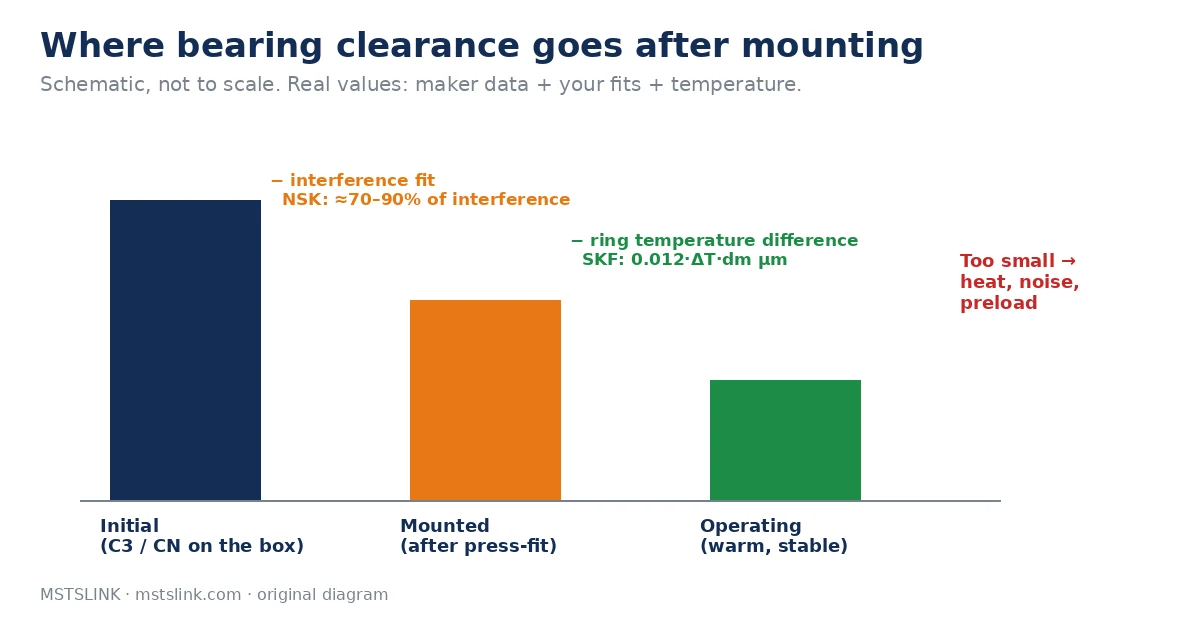
SKF separates three stages (SKF, selecting clearance):
- Initial clearance: before mounting. This is what C3 or CN describes.
- Mounted clearance: after mounting, before running.
- Operating clearance: in operation, at stable temperature.
Effect 1: interference fit
When the inner ring is pressed onto the shaft, it expands. When the outer ring is pressed into a housing, it is compressed. Both reduce clearance. SKF gives the reduction as the effective interference times a reduction factor for each ring (SKF, interference fits). NSK states that the reduction is approximately 70 to 90% of the interference (NSK TI, NSK catalog E9010c).
So the shaft tolerance matters as much as the bearing. A shop that machines the shaft to the tight end of the tolerance takes more clearance out than one at the loose end.
Effect 2: temperature difference between the rings
Heat from the bearing leaves mainly through the housing. NSK notes that the inner ring and rolling elements normally run 5 to 10 °C warmer than the outer ring, and more if the shaft is heated or the housing cooled (NSK TI). SKF's estimate for a steel shaft and steel or cast iron housing is Δr_temp = 0.012 × ΔT × d_m (µm), where d_m = (d + D)/2 in mm (SKF, temperature difference).
Worked example (formula only): a 6205 has d = 25 mm and D = 52 mm, so d_m = 38.5 mm. With ΔT = 10 °C, SKF's formula gives about 0.012 × 10 × 38.5 ≈ 4.6 µm of clearance loss from temperature alone. That loss comes on top of the fit reduction. SKF also points out that start-up can create a larger temperature difference than steady state, especially outdoors in cold climates. That is relevant for buyers in Canada and Russia.
SKF combines these effects into one rule: the required minimum initial clearance equals the required operating clearance plus the fit reduction, the temperature reduction and other effects. Then you pick the class whose minimum clearance meets that value (SKF, required minimum).
What happens if the clearance is wrong?
NSK states that internal clearance affects service life, vibration, noise level and heat generation (NSK TI).
- Too little clearance: the bearing can run with unintended preload. It generates more heat, the heat reduces clearance further, and the bearing may run hot, get noisy or fail early.
- Too much clearance: more play, more vibration and noise, and the load is carried by fewer rolling elements.
NSK lists application examples that typically use C3 or C4. Among them are conveyor rollers in rolling mills (C3), vibrating screens (C3, C4) and traction motors for trains (C4) (NSK TI). These are examples, not rules for your machine.
Why can't you choose C3 vs CN from the catalog alone?
The catalog tells you the clearance range of an unmounted bearing. It does not know:
- your shaft and housing tolerances, and therefore the real interference;
- the shaft and housing material and wall thickness;
- the speed, load and temperature difference in your machine;
- whether the outer ring is also an interference fit.
That is why "the old one was a 6205, so any 6205 will do" is risky. A 6205 with CN and a 6205-C3 share a base number but behave differently once mounted. NSK notes that CM (electric-motor clearance) may be used in place of CN, but not the reverse (NSK industrial catalog). Clearance groups are not freely interchangeable.
Practical rule: keep the clearance class of the original bearing unless an engineer has re-checked the fit and temperature. If the original marking is worn, ask the machine maker or check the service manual before you order.
What measured clearance data should you request from the factory?
Datasheet values are ranges. Ask for numbers measured on your batch.
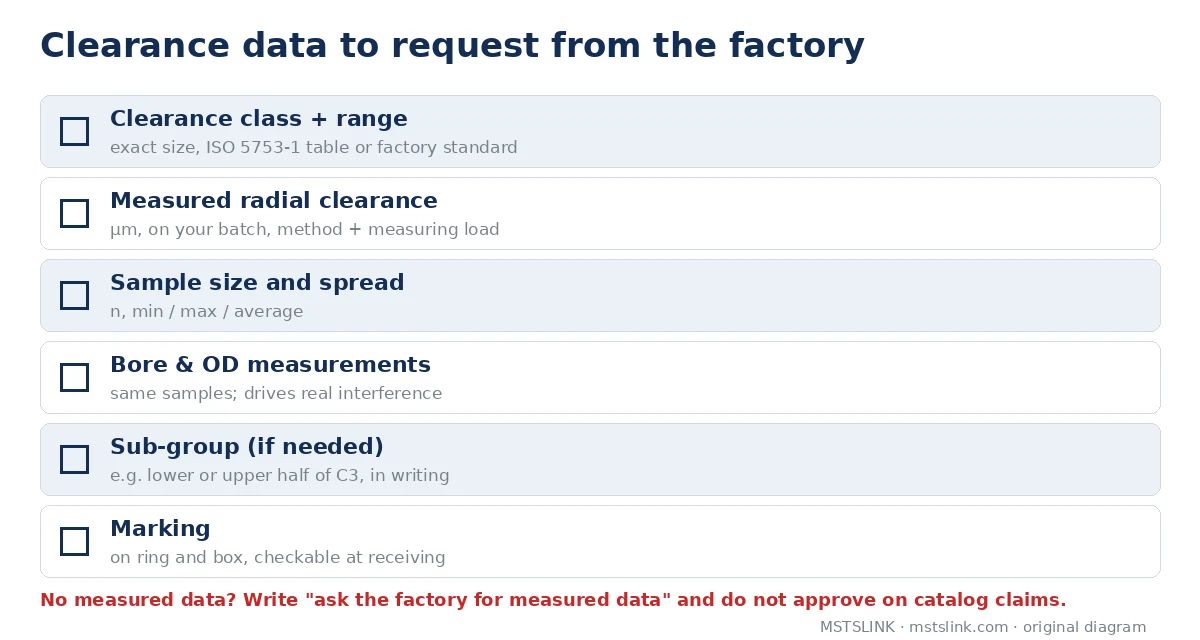
- Clearance class and its range for the exact size, with the reference (ISO 5753-1 table or factory standard).
- Measured radial internal clearance on samples from your batch, in µm, with the measuring method and measuring load. ISO 5753-1 notes that clearance is measured under a load, and that elastic deformation must be accounted for.
- Sample size and spread: how many bearings were measured, minimum, maximum and average.
- Bore and outside diameter measurements on the same samples. These affect the real interference on your shaft.
- Sub-group, if you need a narrower range (for example a lower or upper half of C3), stated in writing.
- Marking: how the clearance class appears on the ring and on the box, so you can check at receiving.
If a factory cannot give measured values, write "ask the factory for measured data" in your spec, and do not approve on the catalog claim alone.
How MSTSLINK helps
As a China Sourcing Agent, MSTSLINK works on the buyer's side. We don't hold stock; we quote line by line from your part-number list. A cross-reference number is only a candidate until the factory verifies it and a sample is confirmed. For bearing projects we can:
- Turn your bearing list into a spec sheet with base number, seals, cage, clearance class and precision class.
- Request measured clearance and dimension data from factories and compare them line by line.
- Arrange sample checks and marking photos before you approve a batch.
- Flag gaps, such as a missing clearance class or an unclear suffix, so you can decide.
We do not quote prices, lead times or certifications in articles. Those depend on the exact bearing and factory, and we confirm them case by case.
Send us your part-number list through mstslink.com/contact or on WhatsApp +86 130 3931 8208. See also our bearings and sealed ball bearings pages.
FAQ
Is C3 always better than CN?
No. C3 has more clearance before mounting. Whether that is right depends on your fit and temperature. Too much clearance adds play and noise.
Why does a bearing lose clearance when pressed on?
The interference fit expands the inner ring (or compresses the outer ring). NSK states about 70 to 90% of the interference shows up as clearance reduction.
How much does temperature reduce clearance?
SKF estimates 0.012 × ΔT × d_m µm for steel parts. For a 6205 with a 10 °C ring difference that is about 4.6 µm.
Can I replace a C3 bearing with a CN bearing of the same number?
Not without checking. Keep the original class unless an engineer has re-checked fit and temperature.
What clearance data should a factory provide?
Clearance class and range, measured radial clearance with method and load, sample size and spread, and bore/OD measurements.
Does MSTSLINK keep bearings in stock?
No. We quote line by line from your part-number list, and each cross-reference stays a candidate until the factory verifies it and a sample is confirmed.
Sources
Brand names and part numbers are cited for reference only; MSTSLINK is not affiliated with or an authorized distributor of these brands.
- ISO 5753-1:2009, radial internal clearance for radial bearings: https://www.iso.org/standard/44742.html
- SKF, Internal clearance: https://www.skf.com/group/products/rolling-bearings/principles-of-rolling-bearing-selection/general-bearing-knowledge/bearing-basics/internal-clearance
- SKF, Selecting internal clearance or preload: https://www.skf.com/group/products/rolling-bearings/principles-of-rolling-bearing-selection/bearing-selection-process/bearing-execution/selecting-internal-clearance-or-preload
- SKF, Clearance reduction caused by interference fits: https://www.skf.com/group/products/rolling-bearings/principles-of-rolling-bearing-selection/bearing-selection-process/bearing-execution/selecting-internal-clearance-or-preload/initial-internal-clearance/reduction-interference-fits
- SKF, Clearance reduction caused by temperature difference: https://www.skf.com/us/products/rolling-bearings/principles-of-rolling-bearing-selection/bearing-selection-process/bearing-execution/selecting-internal-clearance-or-preload/initial-internal-clearance/reduction-temp-difference
- SKF, Required minimum initial internal clearance: https://www.skf.com/group/products/rolling-bearings/principles-of-rolling-bearing-selection/bearing-selection-process/bearing-execution/selecting-internal-clearance-or-preload/initial-internal-clearance/required-minimum
- NSK, Internal Clearance: Types and Norms (PDF): https://www.nsk.com/content/dam/nsk/am/en_us/documents/bearings-americas/TI%20Internal%20Clearance.pdf
- NSK, catalog E9010c (PDF): https://www.nsk.com/content/dam/nsk/common/catalogs/ctrgPdf/bearings/e9010c.pdf
- NSK, Rolling Bearings for Industrial Machinery, part C (PDF): https://www.nsk.com/content/dam/nsk/common/catalogs/ctrgPdf/bearings/e1103c_partc.pdf
- NTN Americas, Numbering System Quick Reference Guide (PDF): https://ntnamericas.com/wp-content/uploads/2025/12/UPDATED-NTN-Catalog-Gen-NomenclatureQRG-A-22NTNQREF.pdf