Oil Filter Cross-Reference: 5 Checks Before You Swap a Part Number
By MSTSLINK (China Sourcing Agent) · Published 2026-11-02 · Updated 2026-11-02
Short answer: A cross-reference chart tells you which filters are listed as interchangeable. It does not prove they are. Before you replace one oil filter part number with another, compare five things side by side: (1) thread size and pitch, (2) gasket inner and outer diameter, (3) height, (4) bypass valve opening pressure, and (5) the anti-drainback valve. Manufacturer catalogs such as MANN-FILTER and WIX publish most of these values per part, and the test methods behind them are defined in ISO 4548 and SAE oil filter test procedures. If any of the five is missing or different, do not swap yet.
This guide is written by MSTSLINK (MSTS Link), a China Sourcing Agent for OE-spec oil and air filters, bearings and CNC parts. It is meant for importers, distributors and workshops in the US, Canada, the UAE, Russia and other markets that buy filters by part number.
Why is a cross-reference number not enough?
Cross-reference tables are built to help a buyer find candidates fast. They usually match by application (engine, model year) and by the main fit dimensions. What they often leave out:
- Valve settings. Two filters with the same thread and size can carry different bypass settings, because bypass opening pressure varies by vehicle and engine. MANN-FILTER lists W 68/3 at 14.5 psi (MANN W 68/3), while WIX lists 57013 at 0.48 bar (WIX 57013). Match the OE value or the filter maker's published spec, not a "same size" listing.
- Valve presence. Whether an anti-drainback valve is fitted depends on how the filter is mounted on the engine. FRAM explains the valve is "included in the filter when required" (FRAM FAQ).
- Units. European catalogs often give bypass pressure in bar, US catalogs in psi. A value of 0.48 bar on a WIX product page is about 7 psi (WIX 57013). Mixed units in a spreadsheet are a common source of wrong swaps.
If a swap goes wrong, the first symptom is often a leak at the seal right after installation. We covered the installation side in Oil Filter Leaking After Change: Double Gasket, Over-Tightening & How Buyers Prevent It. This article covers the spec side: what to compare before the order.
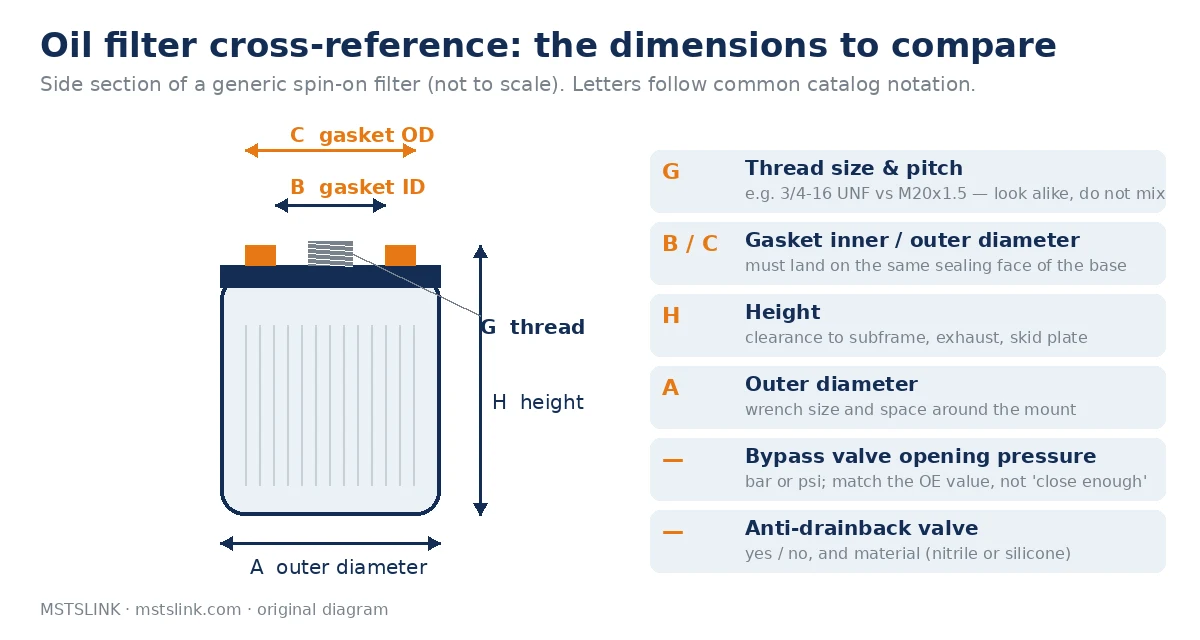
Check 1: Is the thread size and pitch exactly the same?
The thread (G) is the first gate. Common spin-on threads include 3/4-16 UNF, M20x1.5, M18x1.5 and M16x1.5; for example MANN-FILTER lists W 68/3 at 3/4-16 UNF (MANN W 68/3) and W 712/75 at M18x1.5 (MANN W 712/75), and WIX lists 57013 at M16x1.5 (WIX 57013).
The trap is that some pairs are close. 3/4-16 UNF has a major diameter of 19.05 mm and a pitch of 1.5875 mm (16 threads per inch). M20x1.5 is 20 mm with a 1.5 mm pitch. They can start by hand and feel normal for a few turns, then bind, cross-thread or seat without proper gasket load.
What to do:
- Write thread size and pitch in the spec sheet, in the original unit (UNF or metric). Do not convert 3/4-16 into "M19" or similar.
- When a sample arrives, check it with a thread gauge or a go/no-go ring. Do not rely on "it screwed on".
- For a new supplier, ask for the drawing that shows thread class or tolerance, not just the nominal size.
Check 2: Do the gasket inner and outer diameters match the sealing face?
The gasket must land fully on the machined sealing face of the engine's filter base. Catalogs give this as gasket inner diameter (B) and outer diameter (C). MANN-FILTER, for example, lists W 68/3 with B = 55 mm and C = 62 mm, and W 712/75 with B ≈ 2.4 in and C ≈ 2.8 in (MANN W 68/3, MANN W 712/75). Some data sheets also give gasket thickness, so ask for it when it is not listed.
A gasket that is too large can overhang the face. One that is too small can sit on a step or a casting edge. Either way, the seal may hold at idle and weep under pressure or heat.
What to do:
- Compare B, C and thickness, all three, against the OE part or the base drawing.
- Agree a tolerance with the factory in writing before production, and measure samples with calipers.
- Record gasket material too (for example NBR vs. ACM/FKM). Our earlier article covers material and heat in more detail (MSTSLINK leak guide).
Check 3: Will the height fit the space, and does it change the filter's capacity?
Height (H) and outer diameter (A) decide whether the filter fits next to subframes, exhaust parts, skid plates and the wrench. A taller filter can also mean more media area; a shorter one can mean less. Catalogs list it per part, such as 75 mm for MANN W 68/3 and 63.5 mm for WIX 57013 (MANN W 68/3, WIX 57013).
What to do:
- Treat a different height as a change that needs a reason, not a free substitution.
- For workshops: check the fit on the actual vehicle before you stock a "universal" alternative in volume.
- For distributors: if you sell a shorter filter against a taller OE number, ask the factory for flow and capacity data from the same test method (ISO 4548-1 covers differential pressure/flow, ISO 4548-12 covers efficiency and capacity, as listed in the ISO 4548-9 preview).
Check 4: Is the bypass valve opening pressure the same as the OE value?
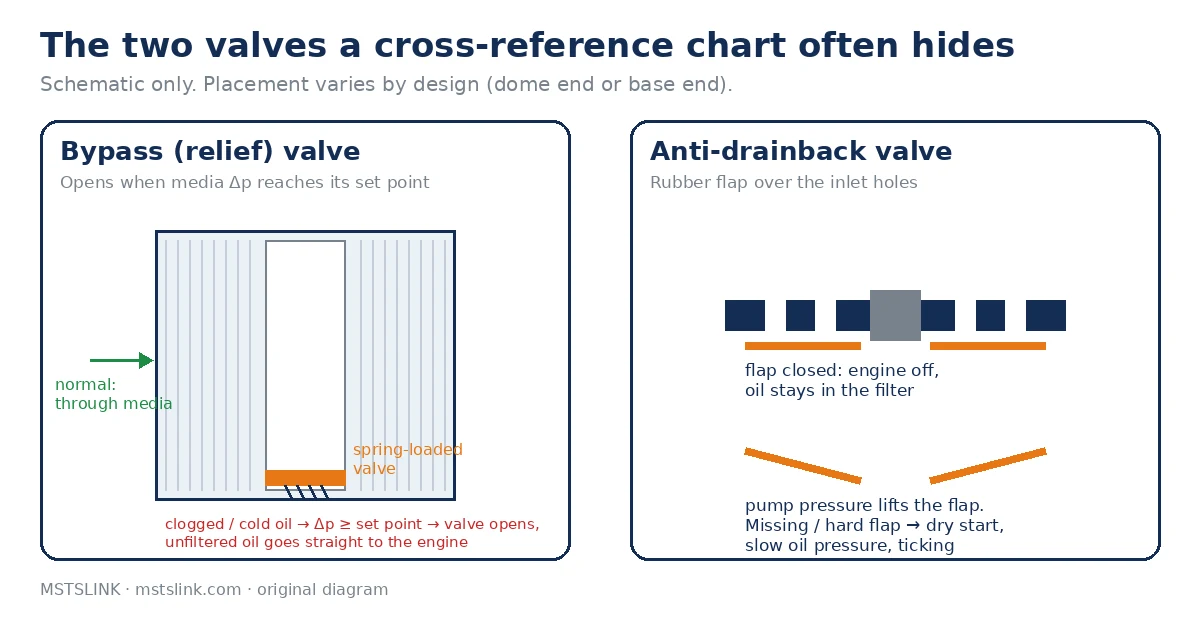
In a full-flow system, the bypass (relief) valve lets oil skip the media when the filter is clogged or the oil is cold and thick. FRAM describes it this way: when contaminant builds up to a preset pressure differential, "around 10-12 PSI in most passenger cars," the valve opens, because "unfiltered oil is far better than no oil at all" (FRAM FAQ). FRAM also notes the valve is built into the engine block on some cars and into the filter on others (FRAM, "Three vital valves").
Bypass opening pressure varies by vehicle and engine. Published catalog values include 14.5 psi for MANN W 68/3 (MANN) and 0.48 bar (≈7 psi) for WIX 57013 (WIX). Match the OE value or the filter maker's published spec for the exact application.
- Too low for the engine: the valve opens more often, so more unfiltered oil reaches bearings.
- Too high: on a cold start or a loaded filter, the media carries more pressure before relief, which stresses the element.
- Engine has its own bypass: the filter may be specified without one. Fitting the wrong type changes the system behaviour.
The test method for this value is ISO 4548-2, "Element by-pass valve characteristics" (ISO). SAE's oil filter test procedure (J806, later published as HS-806) also covers relief valve performance (SAE J806 via GlobalSpec).
What to do: put the OE bypass value, with its unit, in the purchase spec. Ask the factory which method produced their number (ISO 4548-2 or equivalent) and whether it is the "crack open" or "full open" pressure, because catalogs do not always say.
Check 5: Does the substitute have the same anti-drainback valve?
The anti-drainback valve is "a rubber flap that covers the inside of the inlet holes of the filter." It keeps the filter full when the engine is off, so "when the engine is started there will be an almost instantaneous supply of oil" (FRAM FAQ). Filters mounted sideways or upside-down depend on it most. Catalogs list it as a yes/no field or as a count; MANN W 68/3, for example, shows one anti-drain back valve (MANN). WIX highlights silicone anti-drainback valves on its premium line (WIX 57013).
If the OE filter has one and the substitute does not, or if the flap is weak or hardens in cold weather, the engine may run briefly with low oil pressure at start-up. Drivers notice it as a delayed oil-pressure light or a short ticking noise.
The test method is ISO 4548-9, "Inlet and outlet anti-drain valve tests" (ISO 4548-9 preview).
What to do: match "valve yes/no" with the OE part, and record the valve material (nitrile or silicone) if your market sees cold winters, such as Canada or Russia, or very high under-hood heat, such as the UAE.
The 5-check worksheet
Use this table for every proposed substitution. One blank cell means the swap is not ready.
| # | Check | Where to find it | Pass rule |
|---|---|---|---|
| 1 | Thread size and pitch (G) | Catalog "Thread Size", drawing | Identical, same standard (UNF or metric) |
| 2 | Gasket ID / OD / thickness (B, C) | Catalog, drawing, caliper on sample | Same sealing face, tolerance agreed in writing |
| 3 | Height (H) and outer diameter (A) | Catalog, fit check on vehicle | Fits; any change has a stated reason |
| 4 | Bypass valve opening pressure | Catalog, ISO 4548-2 report | Same as OE, same unit, method stated |
| 5 | Anti-drainback valve | Catalog yes/no, ISO 4548-9 report | Same as OE; material noted |
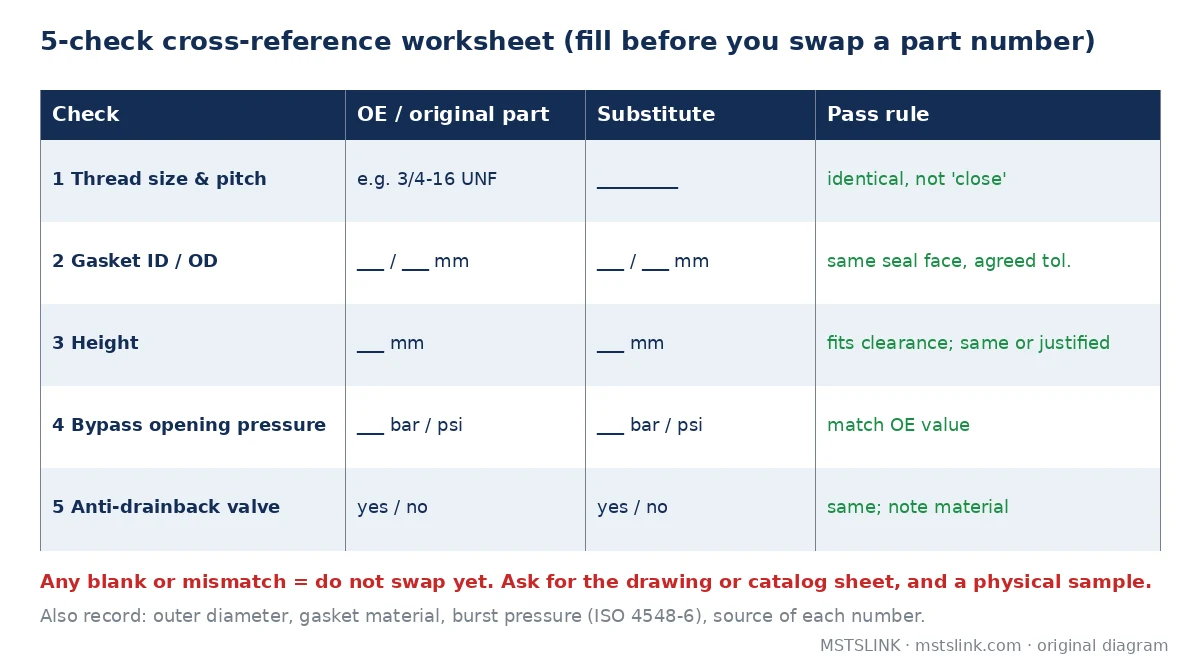
Beyond the five checks, it helps to ask for burst pressure (ISO 4548-6) and filtration efficiency data where your customers expect it. Keep the source of every number (catalog link, drawing revision, test report) next to the value.
How MSTSLINK helps with cross-reference checks
As a China Sourcing Agent, MSTSLINK works on the buyer's side. For filter projects we can:
- Turn your OE or competitor part numbers into a written spec sheet covering the five checks above.
- Request drawings and catalog data from factories and compare them line by line.
- Arrange sample measurement (thread, gasket, height) and photo records before an order.
- Flag gaps, such as a missing bypass value or a unit mismatch, so you can decide.
We don't hold stock; we quote line by line from your part-number list. A cross-reference number is only a candidate until the factory verifies it and a sample is confirmed. We do not quote prices, lead times or certifications in articles. Those depend on the exact part and factory, and we confirm them case by case.
Send us your part number list through mstslink.com/contact or on WhatsApp +86 130 3931 8208. See also our spin-on oil filters and auto parts pages.
FAQ
Can I use an oil filter if only the thread matches?
No. Thread is only the first check. Gasket diameters, height, bypass pressure and the anti-drainback valve also need to match the original part.
Are 3/4-16 UNF and M20x1.5 interchangeable?
No. They are close in size (19.05 mm vs. 20 mm) but have different pitch (1.5875 mm vs. 1.5 mm). Do not mix them.
What is a normal bypass valve opening pressure for an oil filter?
FRAM cites around 10–12 psi for most passenger cars, but catalog values differ widely by engine, from about 7 psi (0.48 bar) to well above 14.5 psi. Always match the OE value.
Does every oil filter need an anti-drainback valve?
No. It is fitted when the mounting position lets oil drain out of the filter when the engine is off. If the original has one, the substitute should too.
Which standards cover these tests?
ISO 4548-2 covers bypass valve characteristics, ISO 4548-9 covers anti-drain valves, and ISO 4548-6 covers burst pressure. SAE J806 / HS-806 is the SAE oil filter test procedure.
Is a cross-reference chart from a filter brand reliable?
It is a good starting point for finding candidates. Confirm each candidate with the five checks and the maker's own product data sheet before you change a part number.
Sources
Brand names and part numbers are cited for reference only; MSTSLINK is not affiliated with or an authorized distributor of these brands.
- FRAM, Frequently Asked Questions (relief/bypass and anti-drainback valves): https://www.fram.com/resources/faqs
- FRAM, "Three vital valves" tech document (PDF): https://www.fram.com/media/wysiwyg/resources/consumer_tech_docs/threevital.pdf
- MANN-FILTER catalog, W 68/3: https://www.mann-filter.com/us-en/catalog/search-results/product.html/w68/3_mann-filter.html
- MANN-FILTER catalog, W 712/75: https://www.mann-filter.com/us-en/catalog/search-results/product.html/w712/75_mann-filter.html
- WIX Filters catalog, 57013: https://www.wixfilters.com/en-ap/catalog/results/product.html/57013_wix.html
- ISO 4548-2:1997, Element by-pass valve characteristics: https://www.iso.org/standard/21712.html
- ISO 4548-9:2008 preview, Inlet and outlet anti-drain valve tests: https://webstore.ansi.org/preview-pages/ISO/preview_ISO+4548-9-2008.pdf
- SAE J806 Oil Filter Test Procedure (GlobalSpec listing): https://standards.globalspec.com/std/14683958/j806-198306
- MSTSLINK, Oil Filter Leaking After Change: https://mstslink.com/blog/oil-filter-leaking-after-change-double-gasket/