Sample, First Order, Repeat Order: Where an Oil Filter Can Change Under the Same OE Number
By MSTSLINK (China Sourcing Agent) · Published 2026-11-02 · Updated 2026-11-02
Short answer: An OE or cross-reference number fixes fit and application. It does not fix how the filter is built. Between the approved sample, the first order and later repeat orders, a factory can change the anti-drainback valve material, the bypass spring, the media, the gasket compound or the shell thickness, and the label stays the same. The defence is the same at every stage: write the build into the contract, seal samples from the approved build, and check each batch against them.
This guide is written by MSTSLINK (MSTS Link), a China Sourcing Agent for OE-spec oil and air filters, bearings and CNC parts. It is for importers, distributors and workshops in the US, Canada, the UAE, Russia and other markets that buy spin-on oil filters by part number.
Why do builds change while the number stays the same?
A part number is a label for fit and application. The build behind it is a set of factory choices: which valve, which media, which rubber, which steel. Buyers who cut open filters from different batches or origins regularly report the same thing: one number, a different valve colour, a different base plate or a different gasket. It is one of the questions overseas buyers ask us most.
The gap can also reach the workshop. In a case from a Chinese repair technician's case library, an aftermarket oil filter leaked at the base after service. The technician traced it to a deformed filter mount and named two likely causes: a sealing ring that was too thick, or tightening beyond the specified torque. The filter "looked fine." The difference was one dimension nobody had locked down.
For leaks after installation, see Oil Filter Leaking After Change. For fit checks before you accept a new number, see Oil Filter Cross-Reference: 5 Checks Before You Swap a Part Number.
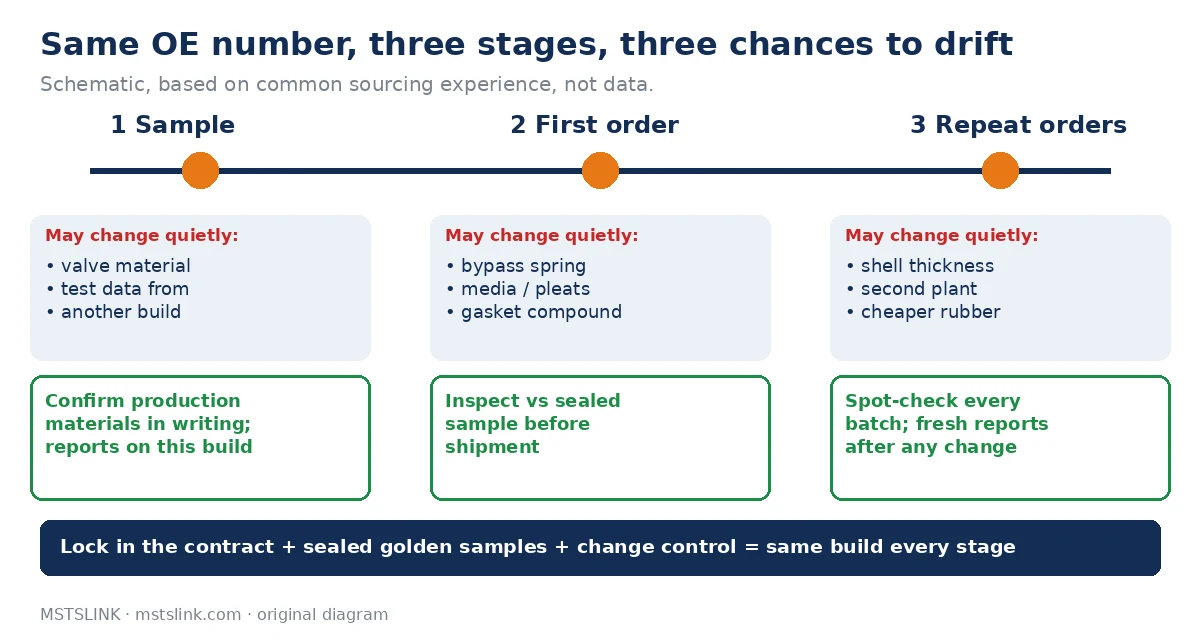
Stage 1: The sample — what you approve may not be what gets built
Samples are often hand-picked, made from the best materials on hand, or taken from another customer's run. That is not dishonest by itself, but it means the sample may not represent the production build.
What tends to differ quietly at this stage:
- Anti-drainback valve material. The valve is a rubber flap that keeps oil in the filter when the engine is off (FRAM FAQ). Makers name the material when it matters. WIX, for example, promotes silicone valves on its premium line (WIX 57013). A sample with silicone and a production run with nitrile can carry the same number.
- Test data that belongs to a different build. A report from last year or from another plant does not describe this sample.
What to do: ask the factory to confirm in writing that the sample uses production materials and the production line. Ask for test reports on the sample build itself: ISO 4548-2 for the bypass valve (ISO), ISO 4548-9 for the anti-drain valve (ISO 4548-9 preview), ISO 4548-6 for burst pressure (ISO 4548-6 sample) and ISO 4548-12 for efficiency and capacity (ISO 4548-12). Cut one sample open and photograph the valve, media and gasket.
Stage 2: The first order — volume brings substitutions
The first production order is when the factory buys materials at volume. If a component is short or a cheaper source appears, substitutions can happen here.
What tends to change quietly at this stage:
- Bypass spring. The bypass valve opens when the pressure difference across the media reaches a set value (FRAM, "Three vital valves"). The setting varies by vehicle and engine, and makers publish it per part. MANN-FILTER, for example, lists 14.5 psi for W 68/3 (MANN W 68/3). A different spring from a different supplier can change it.
- Media. Type (cellulose, blend, synthetic), layers, basis weight and pleat count. A thinner or shorter pack can pass a visual check and still lose efficiency and capacity.
- Gasket compound and thickness. Different rubber batches and tolerances, as in the technician case above.
What to do: inspect the first order against the sealed samples before shipment. Check fit dimensions, weight and a cut-open unit, and compare valve colour, pleat count and gasket thickness.
Stage 3: Repeat orders — cost pressure and quiet "improvements"
Once the buyer stops looking closely, small changes add up: a thinner can, a lighter media, a cheaper valve rubber, a second plant. Each one can look minor. Together they can change how the filter performs.
What tends to change quietly at this stage:
- Shell and base plate thickness. A thinner can saves steel. FRAM notes that a stuck pressure regulating valve can over-pressurize a filter, and a deformed filter is a warning sign (FRAM, "Three vital valves"). Burst strength depends on the can.
- Production site. A second plant or a subcontractor with its own materials.
- Anything from stages 1 and 2, especially if nobody compares against the golden sample.
What to do: keep spot-checking every batch, and ask for fresh test reports when the factory, plant or material changes, or after a complaint.
What to lock in the contract
A contract or spec sheet that only says "OE number, equal to original quality" leaves every build choice open. Write down per part number:
| Area | What to write down | Evidence |
|---|---|---|
| Fit | Thread, gasket ID/OD/thickness, height, outer diameter | Drawing with tolerances |
| Anti-drainback valve | Yes/no, material | ISO 4548-9 report |
| Bypass valve | Opening pressure, unit, tolerance | ISO 4548-2 report |
| Media | Type, pleat count, pleat height, area | ISO 4548-12 report |
| Gasket | Compound, dimensions, tolerance | Measurement, material statement |
| Shell | Material, nominal thickness | ISO 4548-6 report |
| Production site | Plant name and address | Written confirmation |
| Change control | No change to any line above without buyer's written approval | Signed clause |
If the factory has no data for a line, write "ask the factory for measured data" and do not accept a verbal claim.
How to seal and keep samples
These are recommendations, not a standard:
- Seal at least two sets from the approved build: one kept by the buyer, one by the factory or the Agent.
- Label each set with part number, factory, plant, date, spec sheet revision and approval reference. Sign or stamp across the seal.
- Keep one cut-open unit with photos of valve, media and gasket, filed with the spec.
- Store them away from heat and sunlight so the rubber parts stay comparable.
- Replace the golden sample only when you approve a new build in writing.
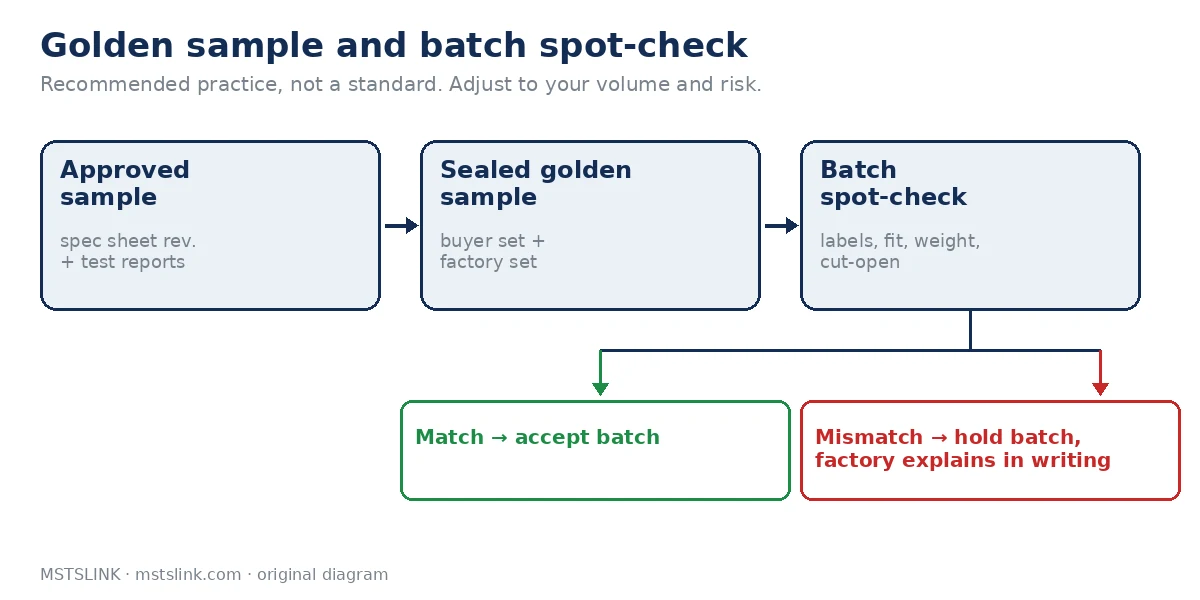
Per-batch spot-check (recommended): labels and batch code; fit dimensions against the drawing; weight against the golden sample; one cut-open unit. ISO 2859-1 offers AQL-based sampling plans if you want a formal scheme (ISO 2859-1).
How MSTSLINK helps
As a China Sourcing Agent, MSTSLINK works on the buyer's side. We don't hold stock; we quote line by line from your part-number list. A cross-reference number is only a candidate until the factory verifies it and a sample is confirmed. For oil filter projects we can:
- Turn your part numbers into a spec sheet that covers the build points above.
- Collect drawings and test reports for the sample build and compare them line by line.
- Arrange sealed golden samples, cut-open photos and batch spot-checks for first and repeat orders.
- Flag changes so you can decide.
We do not quote prices, lead times or certifications in articles. Those depend on the exact part and factory, and we confirm them case by case.
Send us your part-number list through mstslink.com/contact or on WhatsApp +86 130 3931 8208. See also our spin-on oil filters and auto parts pages.
FAQ
Why can the sample be different from the first order?
Samples may be hand-picked or made from other materials. Ask the factory to confirm in writing that the sample uses production materials and the production line.
What tends to change at the first order?
Components bought at volume, such as the bypass spring, media and gasket rubber, may be substituted. Inspect the first order against sealed samples before shipment.
What tends to change in repeat orders?
Cost-driven changes such as shell thickness, media weight, valve rubber or production site. Keep spot-checking each batch against the golden sample.
What should the contract lock in?
Fit dimensions, valve material, bypass opening pressure, media, gasket, shell, production site and a change-control clause requiring your written approval.
How should golden samples be kept?
Seal at least two sets, label them with part number, plant, date and spec revision, sign across the seal, and keep one cut-open unit with photos.
Does MSTSLINK keep filters in stock?
No. We quote line by line from your part-number list, and each cross-reference stays a candidate until the factory verifies it and a sample is confirmed.
Sources
Brand names and part numbers are cited for reference only; MSTSLINK is not affiliated with or an authorized distributor of these brands.
- FRAM, Frequently Asked Questions: https://www.fram.com/resources/faqs
- FRAM, "Three vital valves" (PDF): https://www.fram.com/media/wysiwyg/resources/consumer_tech_docs/threevital.pdf
- MANN-FILTER catalog, W 68/3: https://www.mann-filter.com/us-en/catalog/search-results/product.html/w68/3_mann-filter.html
- WIX Filters catalog, 57013: https://www.wixfilters.com/en-ap/catalog/results/product.html/57013_wix.html
- ISO 4548-2:1997, element by-pass valve characteristics: https://www.iso.org/standard/21712.html
- ISO 4548-6:2012 sample, static burst pressure test: https://cdn.standards.iteh.ai/samples/45761/8aa5532035244d7a88a3e10540af5c9a/ISO-4548-6-2012.pdf
- ISO 4548-9:2008 preview, anti-drain valve tests: https://webstore.ansi.org/preview-pages/ISO/preview_ISO+4548-9-2008.pdf
- ISO 4548-12:2017, filtration efficiency and contaminant retention capacity: https://www.iso.org/standard/62763.html
- ISO 2859-1:2026, sampling procedures by attributes (AQL): https://www.iso.org/standard/2859-1
- MSTSLINK, Oil Filter Leaking After Change: https://mstslink.com/blog/oil-filter-leaking-after-change-double-gasket/
- MSTSLINK, Oil Filter Cross-Reference: 5 Checks: https://mstslink.com/blog/oil-filter-cross-reference-5-checks/