A 200-Line OE List: Why Only About Half Can Be Quoted (and How to Fix Yours)
By MSTSLINK (China Sourcing Agent) · Published 2026-11-02 · Updated 2026-11-02
Short answer: "200 lines, about half quotable" is a way of describing a familiar experience, not a statistic. When a buyer sends a long OE list for filters or bearings, some lines can be checked and quoted right away. Others first need a question answered: a missing vehicle code, an unclear suffix, a superseded number, or a request we cannot accept, such as original-brand packaging. This article lists the ten most common reasons a line gets held back and shows how to prepare a list that gets line-by-line quotes faster.
This guide is written by MSTSLINK (MSTS Link), a China Sourcing Agent for OE-spec oil and air filters, bearings and CNC parts. It is for importers, distributors and workshops in the US, Canada, the UAE, Russia and other markets that buy by part number.
Why does a long OE list split into "quote now" and "ask first"?
A factory quotes a part it can identify, build to spec and produce in a quantity it can plan. Every line in your list has to pass those three checks. When one piece of information is missing, the line does not get rejected. It goes into a "clarify first" pile. In practice, the larger and more mixed the list, the larger that pile tends to be.
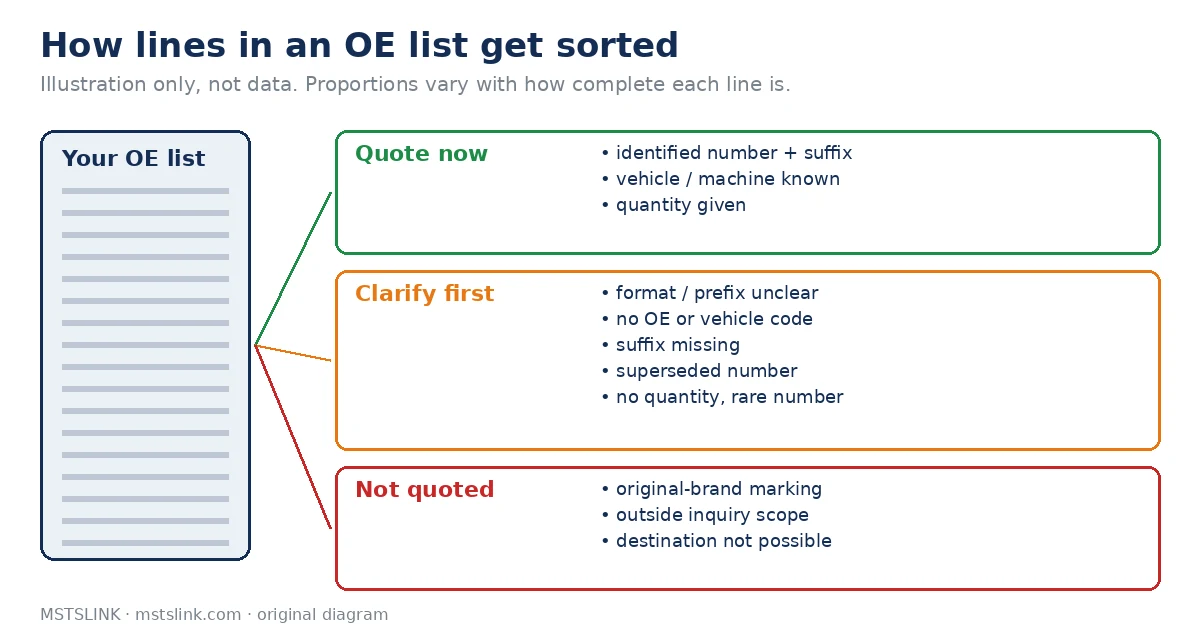
The 10 common pitfalls in an OE list
1. Part numbers written in different formats
Spaces, dashes, slashes and dropped prefixes turn one number into several. A brand number with its letter prefix removed may match a different part, or nothing at all.
Fix: keep the number exactly as written on the part or invoice, and add a second column for your cleaned-up version. Never overwrite the original.
2. Only a retail or internal number, no OE number
A shop's internal code or a retailer's number has to be traced back to the OE number first. That adds one round of questions per line.
Fix: give the OE number where you have it. If you only have a brand number, say which brand.
3. No vehicle or machine information
One OE number can cover several versions: model years, engine codes, before and after a facelift. Without that context, the factory cannot be sure which build you need.
Fix: add make, model, year and engine code for auto parts, or machine model for bearings. For uncertain lines, attach a photo of the old part and measured dimensions. For oil filters that means thread, gasket inner and outer diameter and height, as covered in Oil Filter Cross-Reference: 5 Checks Before You Swap a Part Number.
4. Missing or wrong suffix
This is the classic bearing problem. The base number is right but the suffix is missing: seals or shields, clearance class, cage. SKF, for example, uses suffixes to show seals and clearance different from Normal (SKF designation system, SKF internal clearance). Each maker uses its own codes, so the NTN quick reference guide lists different seal codes for the same function (NTN). Filters have version changes too.
Fix: copy the full marking from the old part, including every letter after the base number.
5. Discontinued or superseded numbers
Older numbers get replaced. A factory may suggest a successor, but that is a change to your part.
Fix: mark lines you know are old. Any replacement number needs your written approval before it is quoted as the line.
6. No quantity, or "as needed"
A factory cannot plan material, tooling or a production run without a number. Low-volume lines may also fall below what a factory is willing to run. That depends on the factory and the part, and it has to be confirmed by the factory.
Fix: give an estimated quantity per line, even if it is a range or an annual estimate.
7. Rare and slow-moving numbers mixed in
One factory rarely covers every line of a long, mixed list. Rare numbers often need a second or third factory, each with its own checks. This is one of the most common reasons only part of a list can be quoted in the first round.
Fix: mark priority (urgent, regular, optional) so the main lines move first.
8. Request for original-brand marking or packaging
Some lists ask for the original maker's logo or box. We do not do this. Marking a part with a brand you do not own raises trademark issues, and goods can be stopped at the border. US Customs and Border Protection, for example, enforces registered trademarks and copyrights at US borders (CBP, Intellectual Property Rights).
Fix: choose neutral packaging, or your own brand with proof that you own or license the trademark.
9. Products outside the inquiry scope
A filter and bearing list sometimes includes body parts, electronics or unrelated goods.
Fix: split those lines out. We mark out-of-scope lines and do not quote them, so the rest of the list is not held up.
10. Destination compliance not stated
The destination affects export rules, payment routes and logistics, especially for Russia. Some items may not be possible for a given destination.
Fix: state the destination country and consignee country on the list. We confirm compliance per order.
How should buyers prepare an OE list for line-by-line quotes?
One row per part number, with these columns:
| Column | Example of what to write |
|---|---|
| Original number | Exactly as on the part or invoice |
| OE number | If known |
| Brand | Brand of the original number |
| Vehicle / machine | Make, model, year, engine code, or machine model |
| Quantity | Estimate or range |
| Packaging | Neutral, or own brand (with trademark proof) |
| Destination | Country of delivery |
| Priority | Urgent / regular / optional |
| Substitute OK? | Yes or no |
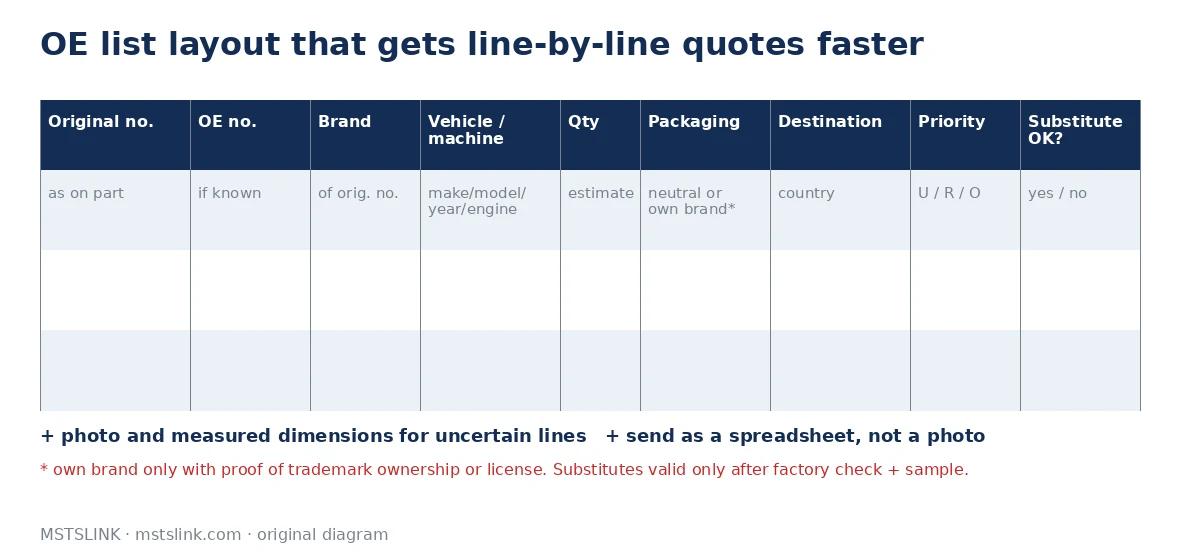
Also:
- For uncertain lines, attach a photo and measured dimensions.
- Say whether you accept substitute numbers. A substitute is only valid after factory verification and sample confirmation.
- Send a spreadsheet, not a photo of a printed list. Numbers copied from images are a common source of format errors (pitfall 1).
How MSTSLINK quotes an OE list
As a China Sourcing Agent, MSTSLINK works on the buyer's side.
- We don't hold stock; we quote line by line from your part-number list. We do not send a whole catalog.
- A cross-reference number is only a candidate until the factory verifies it and a sample is confirmed.
- Lines that need clarification come back to you with a specific question, not a silent gap.
- Out-of-scope lines and requests we cannot accept, such as original-brand marking, are marked as such.
- We do not quote prices, lead times or certifications in articles. Those are confirmed per part number and quantity.
For filter projects, see also Same OE Number, Different Results From Two Factories and Oil Filter Leaking After Change.
Send us your OE list. Email it through mstslink.com/contact or send it on WhatsApp +86 130 3931 8208. A spreadsheet with the columns above gets the fastest line-by-line answer.
FAQ
Does "about half" mean MSTSLINK can only quote 50% of a list?
No. It is a headline framing for a common experience, not a measured figure. How much of a list can be quoted first depends on how complete each line is.
What is the most useful column to add?
Vehicle or machine information, plus the full original number with all suffixes.
Can you put the original brand's logo on the parts?
No. We supply neutral packaging, or your own brand if you provide proof of trademark ownership or license.
Will you quote a replacement for a discontinued number?
We can propose one, but it only becomes the line after your written approval, factory verification and sample confirmation.
Do you quote the whole list at once?
We quote line by line. Clear lines are quoted first; lines that need information come back with a question.
Do you keep stock?
No. We don't hold stock; every line is checked with factories for your order.
Sources
Brand names and part numbers are cited for reference only; MSTSLINK is not affiliated with or an authorized distributor of these brands.
- SKF, Deep groove ball bearings designation system: https://www.skf.com/group/products/rolling-bearings/ball-bearings/deep-groove-ball-bearings/designation-system
- SKF, Internal clearance: https://www.skf.com/group/products/rolling-bearings/principles-of-rolling-bearing-selection/general-bearing-knowledge/bearing-basics/internal-clearance
- NTN Americas, Numbering System Quick Reference Guide (PDF): https://ntnamericas.com/wp-content/uploads/2025/12/UPDATED-NTN-Catalog-Gen-NomenclatureQRG-A-22NTNQREF.pdf
- U.S. Customs and Border Protection, Intellectual Property Rights: https://www.cbp.gov/trade/priority-issues/ipr
- MSTSLINK, Oil Filter Cross-Reference: 5 Checks: https://mstslink.com/blog/oil-filter-cross-reference-5-checks/
- MSTSLINK, Same OE Number, Different Factories: https://mstslink.com/blog/same-oe-number-different-factories-oil-filter/